Applied Presence: Foundations
Catch yourself going on autopilot, and choose to come back to full contact with your day-to-day life instead.
1,800+ students since 2020
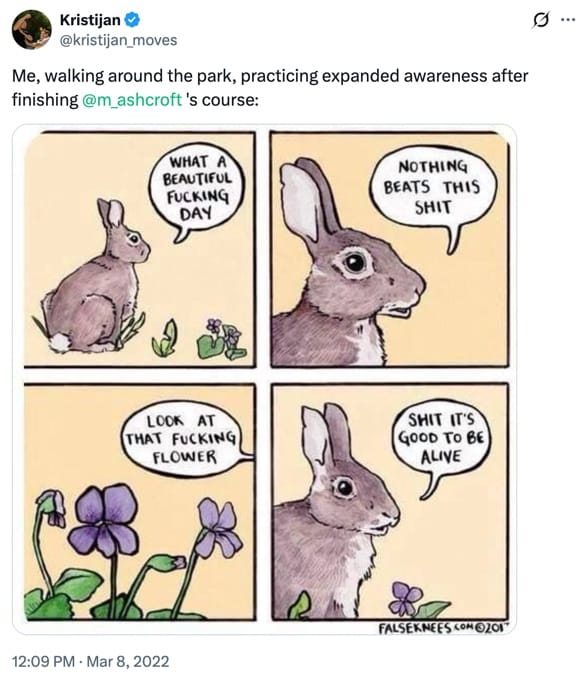
"Never have I experienced a walk in the local park so vividly" — @le_big_mac
"One of the best online courses I've ever bought! [...] 10/10 would expand my awareness again" — @dirceu
You already know what autopilot feels like
Have you scrolled the endless feed on your phone, then realised how much time has passed? Have you driven a familiar route and 'woken up' at your destination? It's an odd experience to remember that the world around you exists, and you within it. Something happened that dimmed the world, locked your attention onto one thing and tightened your body. For a time, you disappeared.
On the other hand, have you choked while playing a sport, one moment playing elegantly, the next moment just getting in your own way? Have you tried to come across naturally on a date and just ended up behaving awkwardly? Here you know you're getting caught up in something unconstructive, but you can't seem to put it down, and trying just makes things worse.
I call all of this going on autopilot. The autopilot is a state where everything you do happens habitually and in a way that always feels familiar. It's functional, but that doesn't mean you're functioning at your best. It takes away your capacity to act in new, unfamiliar ways, and you can't make a new choice if you can't first notice that you have other options.
Most of us live so much of our lives on autopilot that it has become the default. But, as you've doubtless experienced, it's possible to come off autopilot and return to full contact with the world. This state is your birthright, but it usually only comes about by grace. This course is about learning how to return there consciously.
What changes when you learn to come back to presence
In my experience, and that of many students, changes tend to show up in these three ways.
Your experience gets more vivid. The autopilot takes you out of direct contact with the world around you, making things seem dim, distant and somewhat frozen. This work brings about the opposite condition: the world becomes brighter, closer and feels more like a flowing, unfolding thing. When your experience of the world flows, you flow too.
"Walking around this river with expanded awareness feels just like low-dose psilocybin." — @nickcammarata
You function better. The autopilot makes you act in response to a narrow, fixed view of how it thinks the world works, which also usually involves putting in more effort and tension than is necessary. Presence helps you respond naturally and appropriately to what is actually happening.
"Practising this while reading a book. Definite change in cognition, understanding the text in front of me coming much quicker, much less need to re-read challenging concepts. Super powers? maybe." — @_le_big_mac
You regain your agency. When you can notice the autopilot, you can also notice that you have other options besides what it wants. Your habits then need your consent to run, which you can either withhold or give with full awareness of what's happening.
"It gives you a space or pause between the stimuli and your reaction… the space to expand yourself and see if that's exactly how you want to react." — Daniel Rojas
How far each of these goes will vary from person to person, and I'd encourage you to treat the ideas as hypotheses to test in your own life.
Let's get you off autopilot
Applied Presence is the skill of noticing and coming off autopilot so that you can experience your life more vividly, function better and make new, conscious choices.
It's based on the principles of the Alexander Technique, which I've been a certified teacher of since 2017, and adapted for this online, self-directed context. F. M. Alexander, an Australian actor, realised that his autopilot would kick in whenever he spoke on stage: he would lose his voice, and it was impossible for him to speak in a new way. Worse, when he tried to change, he just emphasised his existing habits even more.
The technique he developed was about bringing more conscious awareness and control to his own behaviour, and in the process he discovered that preventing the autopilot both required and revealed a state of consciousness that I (and others) call presence.
Alexander Technique is designed to be practised in activity, integrated into all of life. There are no extra things to add to your life, because you're always doing the thing while going about your days. Applied Presence builds on this tradition: the contents of your own life become your dojo.
And while it may take energy, it's not an effortful practice, because it's fundamentally about doing less, not doing more.
"The skill Michael teaches is not actually difficult to do. In fact, in some ways, doing it is easier than not doing it." — Sasha Chapin
Where traditional Alexander Technique tends to focus mainly on the body, my work applies its principles to everything else, like work, conversations, relationships and emotions. I also happily integrate other relevant traditions and disagree with Alexander whenever I want to.
What some students experience
While I can't and won't promise you any of the results below, I'll gently place in your awareness the fact that some people experience them. (Full disclosure: everything here is from v1 of the course. I think v2 is much better, and v1 is included with your purchase, so you can judge for yourself.)
"diving deep into these videos rewired my experience a pretty persistently. granted i think the depth + speed of impact was partly due to extensive previous meditation. if i had a professional development budget that covered this course, it'd be the first thing i'd buy" — @tasshinfogleman
"It is superb. Taking a touch based practice and extending it virtually while maintaining intimacy is a real feat. Hats off to Michael, I am very grateful. Can be done fast or slow, as long as you do the exercises and learn to add your own." — @dickkurth
"I loved this course, worth doing if you're at all into the stuff I've been tweeting lately" — @danshipper
What you get
Applied Presence⋅Foundations is a self-paced course, with text and video lessons that you can go through whenever you want. You'll have access for as long as the course exists (a long time, I hope), and you'll also get any further upgrades as I build them. You'll also get full access to the previous version of the course.
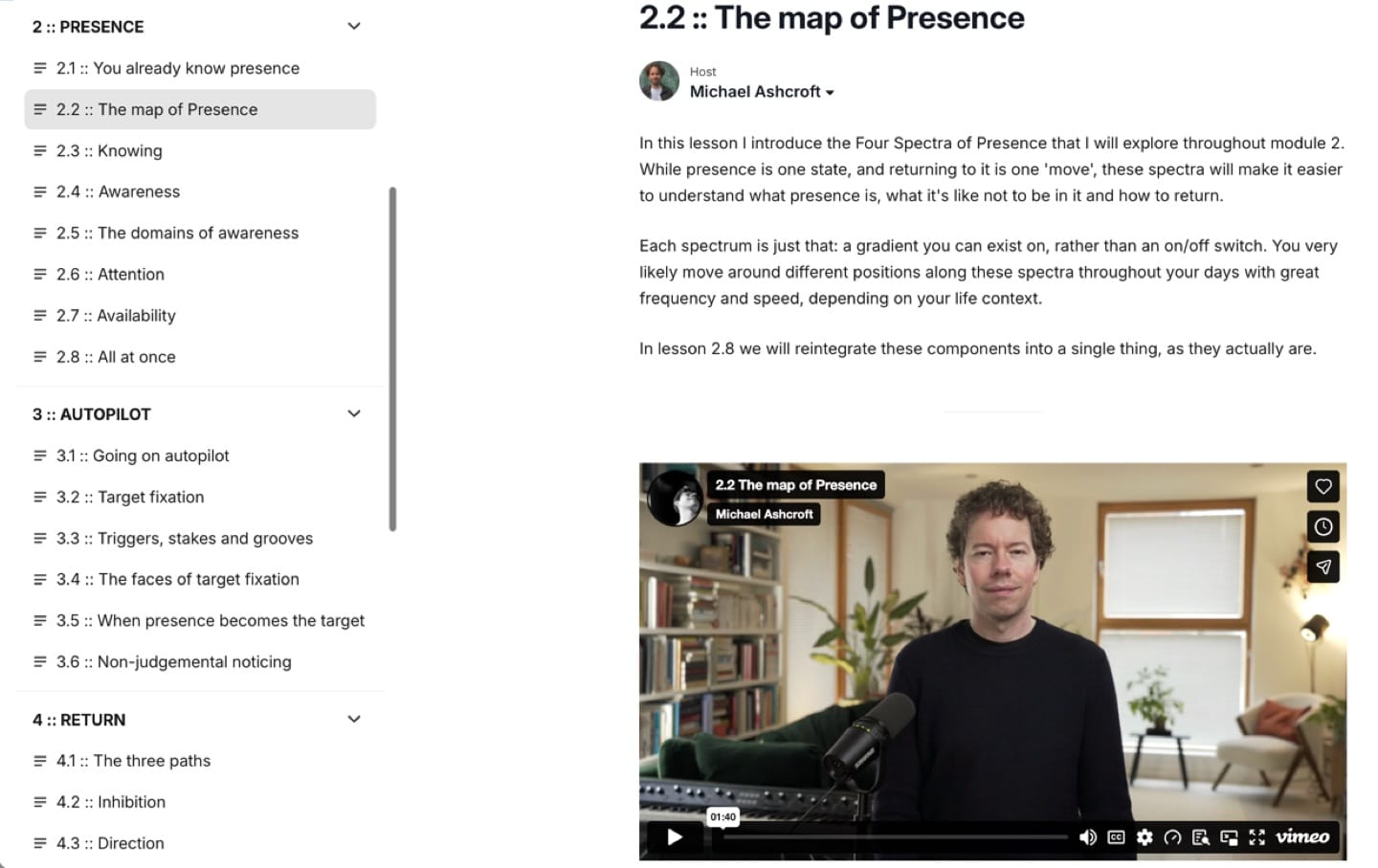
Since the course is about taking this practice into your day-to-day life, every lesson has experiments to explore and ground the practice in daily life. It's designed to be experiential, not intellectual, although there's no shortage of theory to dive into.
Course curriculum
- 1 :: Introduction. I cover the lay of the land and introduce some key ideas early, like how trying is just muscle tension, so that you can apply them immediately and get more from the course.
- 2 :: Presence. I explain what presence is and split it into four spectra that you can explore and experiment with individually, then integrate them all back into one move.
- 3 :: Autopilot. I describe how the autopilot works, what causes it, and why it can be so difficult (or sometimes impossible) to get out of.
- 4 :: Return. I talk about how you may currently respond habitually to triggers in your life, demonstrate a new option and explain how to return to presence without getting yourself more stuck.
- 5 :: Unfamiliar. I describe why your interpretation of your feelings may be repeatedly guiding you back to autopilot, and why feeling unfamiliar is necessary, which is an important idea that I haven't found in many other traditions.
- 6 :: Applied. I show how Applied Presence is a 'householder practice' and give ideas for how to take it into your life.
If you really wanted to, you could probably speedrun the whole thing in a weekend, but I'd really encourage you to go much, much slower. Setting aside about a month at a lower intensity is better, because there are some complex ideas that take time to understand, experiment with and integrate into your life.
"Best online course (of any subject matter) I've ever taken. [...] [it] felt deeply rooted in and geared towards encouraging daily practice in a pragmatic way." — @tweetsbygarrett
No cushions, extra time, or new beliefs required
You may have tried meditation, various apps or even gone on retreats. These can be great in the right context (I meditate, myself), but they are not the right fit for many people. These practices can be difficult to integrate into your daily life and they often come wrapped in a worldview that you may not want.
"It's the best of all the meditation/present moment content I've tried, and that's not a very short list. And Michael delivers it with the least woo, which is so helpful." — Christine Peterson
You may have had some initial success with other mindfulness practices, but later found that they stopped working, you didn't know why, and you gradually forgot about them. Perhaps they felt too unfamiliar and you drifted back to your normal habits. Or maybe you had a few striking new experiences, tried to recreate them, and got stuck.
You may never have tried any of this stuff at all. You're curious, but there are too many options and no obvious place to start.
You may even be an experienced meditator looking to deepen your practice or to take it off the cushion.
"I was surprised that Michael's course was so helpful because I came to it with a number of years of meditation experience under my belt. [...] It deepened my meditation practice, certainly, as well as my experience of just walking around normal life." — Sasha Chapin
This course is probably for you if:
-
You recognised yourself in what I've said so far. If you've noticed the autopilot running your days, taking you further from your own experience and making you get in your own way, that's the dynamic this course explores.
-
You want a practice that's woven into your life. There's nothing extra to schedule and no equipment is needed. Every lesson has experiments that you can play with as you go about your days.
-
You're curious, but a little sceptical. Good! Everything I teach can be tested in your own experience. Please try to falsify what I say, because I approached it that way myself and it really helped me learn.
-
You've bounced off meditation, or you want to deepen a practice you already have. Some students arrive having tried apps and retreats, while others arrive with years of meditation behind them. Either starting point is fine (as is no meditation experience whatsoever, because this isn't meditation).
This course is not for you if:
-
You want a quick fix to some major problem in your life. This course covers a set of skills that you can apply to everything that you do, but going into it expecting to fix something about yourself or the world works against the principles I teach. Your life may very well change dramatically! Or it may not. Trying to fix things just gets you more stuck. On the other hand, if you are in that pattern, then the course may help you understand why it's not working for you.
-
You want a flashy, intense experience. Some people have reported such experiences, but I don't think they went into it expecting it. This is a version of trying to fix things, and trying is not how you get those big experiences that you may want. The good news is that simply tuning into and enjoying the glorious expansiveness, richness and depth of your immediate environment might give you something even better.
-
You want to improve your posture or fix your back pain. You may have read that Alexander Technique is about improving how your body works. This is partly true, but this is not the focus of my work or this course. Your posture may improve, but it isn't the aim, and if you come into it expecting anything to do with anatomy, biomechanics or a strong focus on movement, you will be disappointed. If that's what you're after, in-person lessons with an Alexander Technique teacher will serve you better.
-
You're navigating serious trauma or acute mental health challenges. The aim of this work is to increase your contact with your experience of yourself and the world. As with any practices that share this aim, you may surface things you don't like or that cause you pain. Sometimes, your autopilot dims your experience in a usefully protective way. If any part of you is concerned that this protection shouldn't be tinkered with, please listen to it and work 1:1 with an appropriate professional instead. In this course, I'm a teacher of skills, not a coach or a therapist.
Meet your teacher
Hello, I'm Michael.
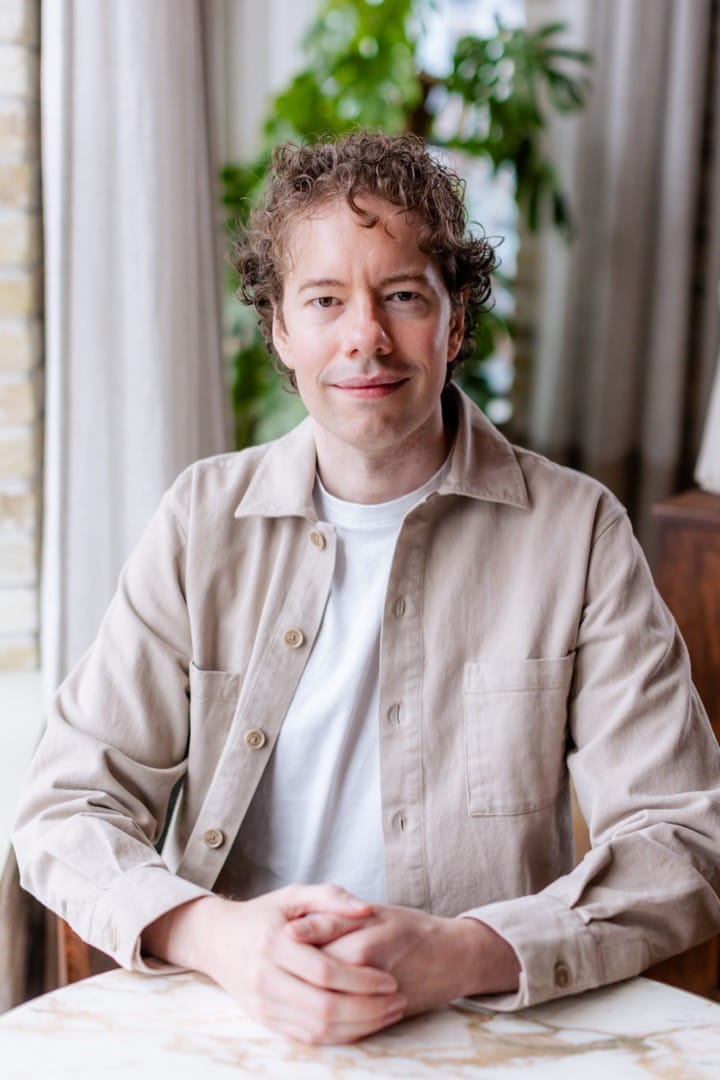
I'm an Alexander Technique teacher certified by Alexander Technique International. My background is a bit unusual for this line of work: I trained as a physicist and spent ten years working in energy system innovation in the UK.
I had my first Alexander Technique lesson with Peter Nobes in 2014 hoping it would be helpful for my knees, which have been unstable since I was a child. I left that lesson experiencing the world as if in 3D for the first time, immediately wanted to dig deeper, and joined Peter's part-time teacher training course.
Throughout the training, I found myself playing the role of sceptic. Peter would invite us to experiment and test various hypotheses, and I would intentionally invert them and try to falsify the claims being made. Despite my best efforts, though, there really was a there there and I ended up qualifying as a teacher in 2017.
I was very online during the pandemic and met many people on Twitter who were interested in this thing I had learned. The first iteration of this course did much better than I expected and I quit my job in 2021. Since then, more than 1,800 people have bought it, and I've been learning, practising and exploring. I launched this new version in August 2026.
I live in London with Cécile and we have, at time of writing, a 1.5-year-old son.
"He really has a gift for educating and teaching these very abstract yet very important ideas." — Cam Houser
Price
The course costs $400, inclusive of any local sales tax.
"If Michael's course does for you what it did for me or even like 20% of that, that would be a pretty crazy return on investment." — Sasha Chapin
My model is to offer the same course at different prices, so that you can choose (at checkout) what feels best for you.
-
Standard - $400 :: This is the price of the course. If the other options below don't apply, this is the one for you.
-
Reduced - $250 :: If paying the standard price would create financial strain or insecurity in your life, you're welcome to pay the reduced price.
-
Supporter - $550 :: If you have financial security and you would like to pay it forward for those who need the reduced price, you are welcome to.
-
Benefactor - $1200 :: If you have financial abundance and you want to support my work then you can do that. I would of course be extremely grateful.
Each of these options gets you the exact same product.
Still on the fence? That's completely reasonable. It can be hard to tell what's inside the thing before you buy it. If it turns out not to be for you, just email me within 30 days of purchase and I'll refund you.
Frequently asked questions
Is this meditation?
No. Meditation can mean a lot of different things, but let's describe it as an intentional period of time where you bring attention to what your experience is like. From there you may choose to concentrate on specific experiences, generate certain experiences, or simply watch and stay uninvolved.
In particular, meditation is usually something you explicitly begin and end. You may sit down, set a timer and finish when a bell rings. You may walk or stand as a meditation. You may be encouraged to 'take your practice off the cushion', but from what I can tell, this is something a lot of meditators struggle with.
What I teach in the course has no beginning and no end, because you are always invited to practise it in the context of everything that you do. Some meditators might still say it's like meditating while going about your day, but I'm cautious about this language, because it can make it seem like you're doing something special.
As an Alexander Technique teacher once said to me, and I'm paraphrasing: teaching Alexander Technique shouldn't look any different from just hanging out in the pub. Nothing special, just your normal life with more awareness of the dynamics of your experience as it's happening.
Of course, there are loads of similarities and overlaps, and I point them out. If you are a meditator, you'll feel right at home here. And if you've never meditated in your life and don't ever want to, you'll also fit in just fine.
Isn't Alexander Technique about posture? How is this different?
You probably don't realise it, but this is an absolute rabbit hole of a question. So, briefly, traditional Alexander Technique that you may have heard about, or even experienced yourself, is usually taught in the context of the body, physical activity and performance. Many teachers develop an expertise in anatomy and work with students via their bodies.
While I can do much of this, it hasn't been my focus. In fact, this is why I decided to give my thing a distinct name — Applied Presence — to give a better sense of the direction I take it in. This name was inspired by Alexander Technique teacher Tommy Thompson, who described Alexander Technique in a workshop I attended as applied, practical consciousness.
Let me quote Peter Nobes' definition of Alexander Technique, from one of his books:
"The Alexander Technique is a powerful method for bringing about profound physical and psychological change. By teaching how to be more conscious and how to pause and reconsider before acting, it empowers people to take charge of their lives; to drop mental and physical habits and become their authentic selves." — Peter Nobes, Illusion or Reality? Are we teaching what FM Alexander was teaching?
Of course this applies to the body, but it applies everywhere else in your life, too. Think of Applied Presence as being 'Alexander Technique for the everywhere else', with a strong focus on the direct experience of the student, with ideas from other relevant traditions increasingly woven in as I learn and explore more. (Just because I have one label doesn't mean I think everything is adequately described by that label.)
How long does the course take?
I suggest going through slowly, perhaps a lesson or two a day. This will give you time to sit with and play with the ideas in your life. At that pace, it would take about a month to go through the whole course.
I suspect that you will want to keep it open in a tab and spiral around it a lot, so you might actually engage with the materials for a lot longer based on what comes up in your practice. Some things might not make sense on the first pass, but may become perfectly clear later on.
I'm not very good at sticking with self-paced courses
That's okay, neither am I. You should see the list of the courses I've abandoned. But I'll say a couple of things on this.
First, I've designed the course so that there's real value throughout. If, for example, you fall off at the end of module 2 (of 6), you will still have learned a bunch of powerful skills that you can apply for the rest of your life.
Second, you have lifetime access (meaning access for as long as the course exists; you might live longer than me), so you can always come back. There are no prizes for forcing yourself through the course when your life circumstances simply aren't conducive to it, nor is there anything wrong with picking it up again three years later.
This is also by design: something in you will tell you when it's appropriate to explore this stuff, and the materials will be waiting for you when that happens. If you get to the end of lesson 2 and then spend two months letting it percolate through your system before returning to lesson 3, that is completely fine.
Is there a community? Can I ask questions?
I learned with the previous version of this course that an inadequately hosted community is worse than none at all, so there are minimal community features for this course. I am experimenting with different ways for students to interact, like a monthly Q&A where you can ask questions anytime and I answer once a month. I may launch a community of practice for a limited number of people, but it will be paid, so I can host it properly.
Learn to return to presence
Going on autopilot is the default for most of us, but it doesn't have to be the whole story. If you'd like to learn to notice when it happens, choose to come off it, and return to full contact with your day-to-day life, I'd be glad to teach you what I know.
Some case studies
If you'd like to read more, here are two little case studies that might interest you:
"Inhibition is one of the most powerful skills you can learn"
Kofi was kind enough to write about his experience with the course and implementing the ideas.
 Michael Ashcroft
"Recently found something that helped me make progress on some ADHD problems that I had been hard stuck on: Alexander Technique (through @m_ashcroft's course)"
Thomas shared some thoughts on Twitter about his experience with ADHD after taking the previous version of this course. I responded to his points here:
 Michael Ashcroft